🏔️ Kanchenjunga: The Sacred Giant of the Himalayas
🌍 Geographical Information
Kanchenjunga is located on the eastern edge of the Himalayas, forming a natural border between Nepal and the Indian state of Sikkim.
Rising with quiet authority between Nepal and India (Sikkim), Kanchenjunga is the third-highest mountain on Earth, reaching an incredible 8,586 meters (28,169 feet).
Its name means “The Five Treasures of Snow”, a reference to its five majestic summits, believed to represent gold, silver, grain, sacred texts, and weapons.
Part of the Himalayan mountain range, Kanchenjunga is not just a peak—it’s a symbol of power, beauty, and spirituality.
🔎 Quick Facts (Synthesis)
| Feature | Data |
|---|---|
| Official name | Kanchenjunga |
| Elevation | 8,586 m (28,169 ft) |
| Location | Border of Nepal & India (Sikkim) |
| Mountain range | Himalayas |
| Meaning of name | “The Five Treasures of Snow” |
🧱 Physical Characteristics
Kanchenjunga’s landscape is wild and dramatic: razor-sharp ridges, deep glacial valleys, and massive ice walls.
The mountain is famous for its five main summits, which dominate the skyline and make it one of the most visually striking peaks on the planet.
Glaciers like the Zemu Glacier feed rivers and ecosystems far below, while the extreme altitude creates some of the harshest climbing conditions in the world.
📊 Physical Profile (Synthesis)
          ▲  Summit I
       ▲     ▲  Summit II
    ▲            ▲  Summit III
       ▲     ▲
          ▲

Prominence : ~3,922 m
Terrain    : Glaciers, steep ridges, ice walls
Type       : High Himalayan peak
Key trait  : Five dominant summits
🧗 Climbing Information
Kanchenjunga is not a beginner’s mountain—far from it.
The first successful ascent was in 1955 by Joe Brown and George Band, who famously stopped just short of the true summit out of respect for local beliefs.
The most common routes are the South-West Face (Nepal) and the North-West Face (India). Even today, Kanchenjunga has one of the highest fatality rates among the world’s highest peaks.
🧭 Climbing Summary (Synthesis)
🧗 CLIMBING OVERVIEW

1955  ── First ascent (Brown & Band)
Routes ── South-West | North-West
Season ── Late April → Early June
Level  ── EXTREME ⚠️
Guides ── Strongly recommended
⚠️ Respect, experience, and preparation are mandatory.
🌿 Flora and Fauna
Despite its extreme environment, Kanchenjunga supports remarkable biodiversity.
Lower altitudes are covered with rhododendron forests, bamboo, and orchids, while higher zones host rare and endangered species.
This region is one of the last strongholds of animals like the snow leopard and the red panda 🐾.
🌿 ALTITUDE & LIFE ZONES

8,500m ─ Ice & Rock ❄️
6,000m ─ Snow Leopards 🐆
4,000m ─ Alpine Meadows 🌱
2,500m ─ Rhododendron Forests 🌸
1,500m ─ Villages & Rivers 🏡

Protected within:
→ Kanchenjunga Conservation Area
🐾 Nature at a Glance (Synthesis)
🕉️ Cultural & Historical Significance
Kanchenjunga is sacred to local communities in Sikkim and eastern Nepal.
Unlike many other peaks, climbers traditionally do not step on the true summit, honoring ancient spiritual beliefs.
For centuries, the mountain has represented balance between humans and nature, making it as culturally powerful as it is physically imposing.
🏔️ Cultural Impact (Synthesis)
| Aspect | Importance |
|---|---|
| Spiritual value | Sacred mountain |
| Historical role | Exploration & reverence |
| Economic impact | Sustainable tourism |
🥾 Tourism & Recreation
You don’t have to be a climber to experience Kanchenjunga.
Trekking through the Kanchenjunga Conservation Area offers lush forests, remote villages, and unforgettable Himalayan views.
The village of Ghunsa is a key base camp, known for its warm hospitality and traditional mountain lodges.
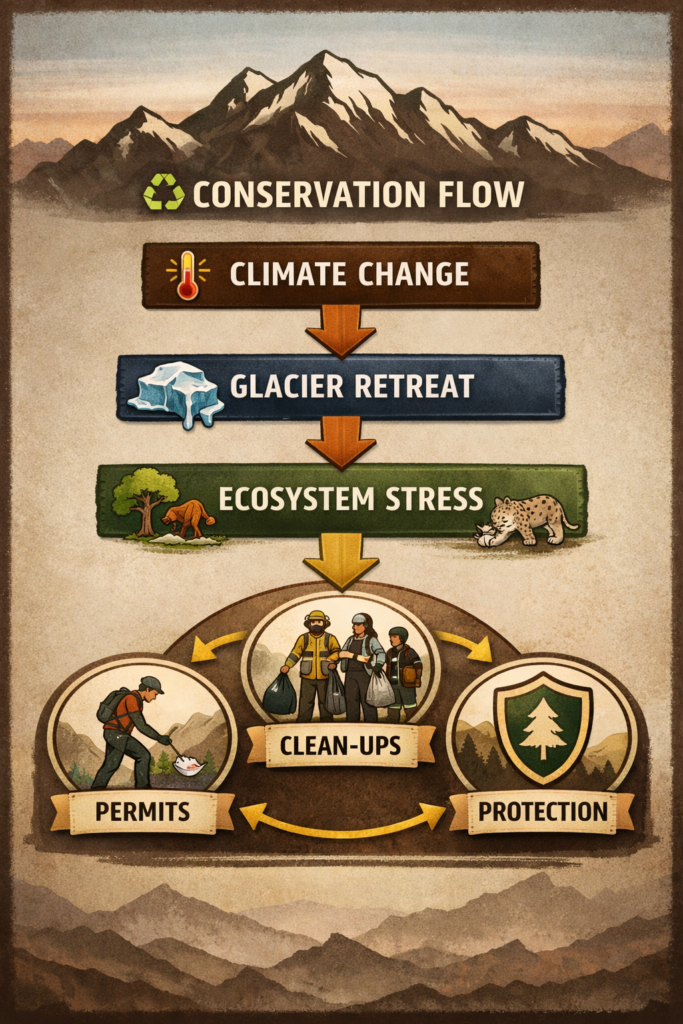
🌱 Environmental & Conservation Issues
Kanchenjunga faces serious challenges:
- 🧊 Glacier retreat
- 👣 Tourism pressure
- 🌡️ Climate change
To counter this, strict regulations, clean-up expeditions, and conservation programs are actively enforced by local and international organizations.
📚 Additional Resources
Want to explore further?
- 📖 Book: “Kangchenjunga: The Untrodden Peak” – Charles Evans
- 🎥 Documentary: “The Call of the Mountain”
- 🌐 Official site: Kanchenjunga Conservation Area
🧠 Practical Tips & Weather
Kanchenjunga’s climate is extreme:
- ❄️ Winters: brutally cold, heavy snow
- 🌸 Spring & 🍂 Autumn: best for trekking
✔️ Always use proper gear
✔️ Respect local guides
✔️ Honor traditions and customs